If you ride with a partner, a pillion or a regular Sunday group, an intercom will change how you ride. Spotting a hazard, calling a fuel stop, or just having a yarn on a long straight is a lot easier when you can talk. The hard part is choosing one.
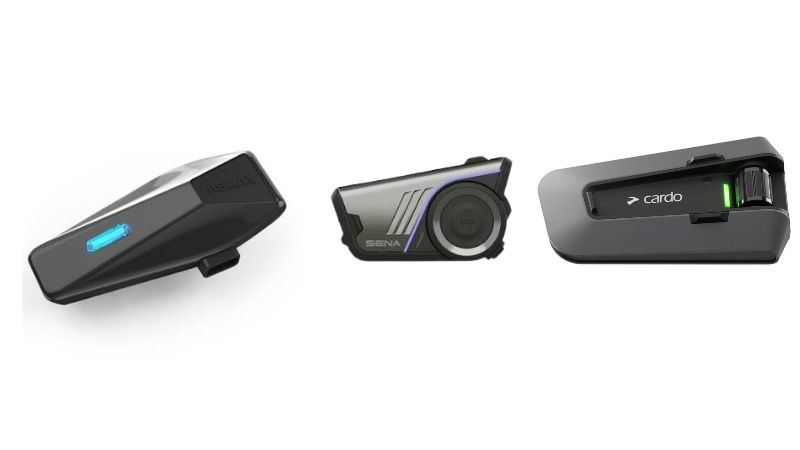
In New Zealand it mostly comes down to three names. Cardo and Sena are the established premium brands, sold at bike shops around the country. ASMAX is a fast-growing Chinese brand mostly bought online, with prices that undercut both by a long way.
How we put this together: we haven’t run a back-to-back test of all three ourselves. This comparison uses manufacturer specs, NZ retail prices (checked October 2026) and independent long-term tests and owner reports. Where claims and real-world results disagree, we say so. Prices change often, so shop around.

The short answer
- Best overall for most riders: Cardo Packtalk Edge or Packtalk Pro. The best audio, a great mount, fully waterproof, and easy to live with.
- Best if your mates already ride Sena: Sena 60S (or 60S EVO). Sena’s mesh connects easily across Sena models, and Wave adds cellular backup when riders get separated.
- Best value: ASMAX S2 or F1 Pro. Surprisingly good for the money, as long as everyone in your group buys ASMAX and you can live with a weaker app and less support.
The models we’re comparing
| Cardo Packtalk Edge | Cardo Packtalk Pro | Sena 60S | ASMAX S2 | |
|---|---|---|---|---|
| NZ price (single) | From about $829 | From about $939 | About $800 (60S EVO about $850) | Roughly $170–$200 (online import) |
| Mesh group | Up to 15 riders | 15+ riders | Large groups, Sena-only mesh | 8 riders (more in app-based modes) |
| Claimed range | 1.6 km rider to rider | 1.6 km rider to rider | Up to 2 km, plus Wave over cellular | Up to 3 km claimed |
| Battery (claimed) | About 13 hours | 13+ hours | Up to about 20 hours | About 10–12 hours talking |
| Speakers | 40 mm JBL | 45 mm JBL | 40 mm Harman Kardon (Bose on EVO) | 40 mm |
| Waterproofing | IP67 | IP67 | See below | IPX7 claimed |
| Extras | Air magnetic mount, voice control | Crash detection, auto on/off, magnetic mount | Wave cellular intercom, voice control | Offline voice control, fast charge |
NZ prices are from major NZ retailers. ASMAX isn’t widely stocked here, so its price is an estimate based on overseas pricing (about €90 for a single S2) before shipping.
Cardo: the one most riders should buy
Cardo’s current range runs from the budget Spirit HD (about $339) and the Bluetooth-only Freecom 4X (from about $599) up to the mesh-equipped Packtalk Edge and flagship Packtalk Pro.
What’s good
- Audio. Cardo’s JBL speakers, especially the 45 mm units on the Packtalk Pro, are widely rated the best helmet speakers available. Speech stays clear at open-road speeds and music sounds rich, not tinny.
- The mount. The Edge and Pro use a magnetic mount that snaps on and off. It’s one of the nicest mounts on any intercom.
- Properly waterproof. Cardo rates its units waterproof, not just water-resistant. For NZ riders who ride in the rain that matters a lot, and long-term testers report few water-related failures.
- Works with other brands (sort of). Cardo can pair with other Bluetooth intercoms, including Sena, using universal Bluetooth pairing. You lose the mesh benefits, but it works in a pinch.
- Safety extras on the Pro. Crash detection can alert emergency contacts through your phone, and auto on/off means you don’t have to remember to switch it on.
What’s not
- Price. A Packtalk Pro costs as much as a decent mid-range helmet. Buying two for you and your pillion or partner gets expensive fast.
- Range is less than claimed. One independent test measured roughly 1.1 km between two Packtalk Edge units, against a claimed 1.6 km. That’s normal for the category. Hills, trees and bends cut range significantly, and NZ roads have plenty of all three.
- Cardo mesh only talks to Cardo. Mixed groups fall back to Bluetooth.
- The mount isn’t perfect for everyone. Some riders find the Edge fiddly to remove with gloves on.
Sena: best for Sena groups and long-distance tourers
Sena has the biggest range of any brand, from the basic SMH5 (about $200) through the slim Spider and R35 models to the flagship 60S and 60S EVO. Sena also makes intercoms built into specific helmets, like the SRL3 for the Shoei Neotec 3 and GT-Air 3.
What’s good
- Easy Sena-to-Sena mesh. Sena Mesh connects across Sena models without much fuss. If your group already rides Sena, this is the path of least resistance.
- Wave Intercom. On Wave-capable models like the 60S, the intercom can switch to mobile data when riders get too far apart for mesh. On NZ roads, with patchy coverage in places, it won’t always work. When it does, it solves the classic problem of the group splitting at traffic lights or a fuel stop.
- Battery life. The 60S claims longer runtime than Cardo’s flagships, which helps on big touring days.
- Helmet-integrated options. If you own a compatible Shoei or another supported helmet, a built-in Sena unit gives a cleaner look, less wind noise and no clamp on the outside.
- Range of price points. There’s a Sena for almost every budget.
What’s not
- Audio is good, not best. The Harman Kardon and Bose speakers are a clear step up from older Sena units, but most reviewers still rate Cardo’s JBL speakers higher.
- Waterproofing questions. Sena has historically described some units as water-resistant rather than waterproof, and there are owner reports of units cutting out in heavy rain. Specs vary by model, so check the rating of the exact unit you’re buying.
- Locked to Sena. Newer Sena mesh only connects to other Sena units, and Wave works only between compatible Sena devices.
- Reliability reports. As with any brand, some owners report dropped connections. It’s worth buying from an NZ retailer that will handle warranty claims for you.
ASMAX: the budget challenger
ASMAX is a Chinese brand that has grown quickly over the last couple of years. Its range includes the budget S1 and S2, and the more premium F1 Plus, F1 Pro and Z1 Plus, which add features like magnetic mounts and auto on/off. In NZ, you’ll mostly find ASMAX through online marketplaces rather than local bike shops.
What’s good
- The price. An S2 costs a fraction of a Cardo or Sena flagship. You could buy a pair for less than one Packtalk Edge.
- Better than you’d expect. Independent reviewers generally say the 40 mm speakers sound better than the price suggests, with decent bass and clear speech.
- Offline voice control. The “Hi Max” voice commands work on the unit itself without a phone signal. Reviewers report it works reliably through wind and engine noise – a real plus on remote NZ roads.
- Specs on paper. Mesh for up to eight riders, IPX7 waterproofing claimed, USB-C fast charging (about three hours of use from a 10-minute charge) and a modern Bluetooth chipset.
What’s not
- The app. Most advanced features run through the ASMAX app, and reviewers and users consistently describe it as buggy, with registration and connection problems.
- Firmware can make things worse. Some owners report updates that hurt performance, with no easy way to roll back.
- Claimed range is optimistic. Like every brand, real-world range falls well short of the advertised figures.
- ASMAX-only mesh. Mixed groups fall back to basic Bluetooth, usually with just one other-brand unit.
- Support and warranty in NZ. This is the big one. Buy a Cardo or Sena from an NZ shop and you have a local retailer and the Consumer Guarantees Act on your side. Buy an ASMAX from an overseas marketplace and a warranty claim may mean posting it overseas and waiting.
Things that matter more than the brand
1. What your mates ride
Mesh intercoms only mesh properly with the same brand. If your regular riding group is all Sena, buying a Cardo means you’ll connect over Bluetooth with reduced features. Ask around before you buy.
2. Range on NZ roads
Advertised range is measured in ideal, line-of-sight conditions. On twisty, hilly NZ roads with bush and cuttings, expect much less. Mesh helps because each unit can relay the signal along the group, but a two-rider pair has no relay. Ride closer together.
3. Rain
We ride in a lot of rain. A unit that’s genuinely waterproof, with a well-sealed charging port, is worth paying for.
4. Your helmet
Check that your helmet has speaker pockets deep enough for 40–45 mm speakers, and room for the clamp or adhesive mount. Some premium helmets, notably newer Shoei models, have dedicated integrated units.
5. Speakers and hearing
Good speakers let you hear clearly at lower volume. Always wear earplugs on the open road – wind noise at 100 km/h can damage your hearing over time – and use good speakers so you don’t have to crank the volume to compensate.
6. Rules on phone use
NZ law restricts using a mobile phone while riding. Hands-free calls through a properly mounted intercom are generally fine, but you can’t handle the phone itself. Use voice control and keep your phone mounted or in your pocket.
Our verdict
For most NZ riders, Cardo is the one to buy. The Packtalk Edge is the sweet spot, and the Packtalk Pro is worth the extra if you want the best speakers and crash detection. Cardo’s waterproofing, audio and mount make it the easiest to live with day to day.
Buy Sena if your group already rides Sena, if you tour long distances and value the extra battery life and Wave’s cellular backup, or if you own a helmet with an integrated Sena option.
Buy ASMAX if budget matters most and you’re buying a matched pair or a set for your whole group. You get a lot of features for the money, but you’re trading away app polish, local support and long-term peace of mind.
Whichever you choose, buy for the group you ride with, keep your expectations realistic on range, and don’t skip the earplugs.
Run any of these intercoms on NZ roads? Tell us how they’ve held up – especially in the rain – in the comments.