

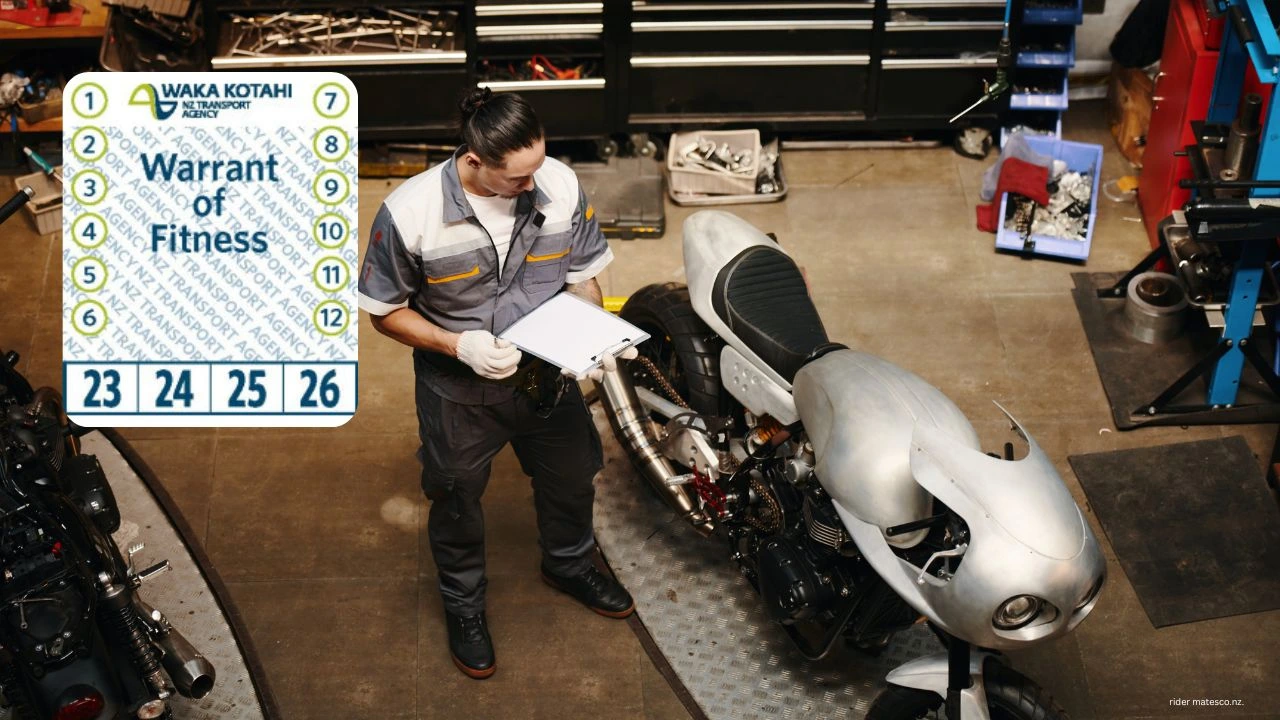
New Zealand’s Warrant of Fitness rules change on 1 November 2026 – the biggest shake-up of the WoF system in decades. Most of the headlines are about cars moving to two-yearly inspections. But what does it actually mean if you ride?
The short version: if your bike was registered before 2000, you’ll save money. If it was registered from 2000 onwards, your WoF schedule doesn’t change. And the fines for an expired WoF or illegal tyres are going up.
This article is based on information published by NZTA Waka Kotahi and the AA as of October 2026. NZTA says more detail is still to come before the changes take effect, so check NZTA for the latest.

What’s changing for motorcycles
| Motorcycle | Current rule | From 1 November 2026 |
|---|---|---|
| Registered before 1 January 2000 | WoF every 6 months | WoF every 12 months |
| Registered on or after 1 January 2000 | WoF every 12 months | No change – still every 12 months |
Older bikes: half the inspections
If you ride a classic, a 90s sportsbike, an old trail bike or a well-loved commuter registered before 2000, you’ll go from two WoFs a year to one. That halves your WoF costs and the hassle of booking in twice a year.
Newer bikes: no change (for now)
This is the bit that’s easy to miss. Cars and other light vehicles aged 4–14 years are moving from annual to two-yearly WoFs, but NZTA’s published schedule lists motorcycles separately – and bikes registered from 2000 onwards stay on annual inspections.
So if you’ve read “WoFs are going two-yearly” and own a 2018 MT-07, don’t skip your next WoF.
The changes for cars (for comparison)
For the cage-driving half of the household, here’s what’s changing for light vehicles like cars:
- New vehicles: second WoF at four years instead of three, from 1 November 2026.
- 4–14 years old, registered on or after 1 November 2019: two-yearly WoFs from 1 November 2026.
- 4–14 years old, registered between 1 November 2013 and 31 October 2019: two-yearly WoFs from 1 November 2027.
- 14–26 years old: no change, still annual.
- Registered before 1 January 2000: annual instead of six-monthly.
- Rental cars: Certificate of Fitness annually instead of six-monthly.
WoF inspections for cars will also include basic checks of driver-assistance systems like automatic emergency braking and lane keep assist, mainly by checking for warning lights.
Bigger fines from 1 November
The government is also increasing penalties:
- Expired WoF (more than two months overdue): fine rises from $200 to $350.
- Non-compliant wheels and tyres: fine rises from $150 to $350, with a maximum court-imposed fine of $1,000.
For riders, the tyre fine is worth paying attention to. Motorcycle tyres wear quickly – especially the rear on a heavy or powerful bike – and the legal minimum tread depth is 1.5 mm.
Why it matters more for riders
Fewer inspections means owners are expected to take more responsibility for keeping their vehicles safe between WoFs. For motorcyclists, that’s nothing new, but it’s worth being honest: on a bike, a worn tyre, a stretched chain or a failing brake is far more dangerous than on a car.
Even if your bike now only needs a WoF once a year, get into the habit of a quick pre-ride check. A simple way to remember it is T-CLOCS:
- T – Tyres and wheels: pressure, tread depth, cracks, spokes, wheel bearings.
- C – Controls: levers, cables, throttle snapping back, brake feel.
- L – Lights and electrics: headlight, tail light, brake light, indicators, horn.
- O – Oil and fluids: engine oil, coolant, brake fluid, and any leaks.
- C – Chassis: chain tension and lube, suspension, steering, frame.
- S – Stands: side stand and centre stand springs and switches.
It takes five minutes, and it’s worth doing before every big ride.
What riders should do now
- Check your bike’s first registration date in NZ – it’s on your registration details and on the NZTA website.
- Pre-2000 bike? Your next WoF after 1 November 2026 should last 12 months. Check NZTA for how current WoF expiry dates will transition.
- 2000 or newer? Keep doing annual WoFs as normal.
- Check your tyres – especially with the higher fine.
- Don’t let your WoF lapse – apart from the bigger fine, an expired WoF can cause problems with insurance claims.
Our take
For owners of older bikes, the move to annual WoFs is a welcome saving. For everyone else on two wheels, very little changes – and that’s arguably no bad thing. Motorcycles are less forgiving of poor maintenance than cars, and an annual check by a professional is a useful safety net. Just make sure you’re checking your own bike in between.
Got an older bike that’ll benefit from the change? Or think motorcycles should go two-yearly too? Let us know in the comments.
Related: Buying a used motorcycle in NZ: the complete checklist · What it really costs to own a motorcycle in NZ